产品名称 | MUC1 Recombinant Rabbit Monoclonal Antibody [SN06-80] |
Product Name | MUC1 Recombinant Rabbit Monoclonal Antibody [SN06-80] |
抗体类型 | 重组兔单克隆抗体 |
Antibody Type | Recombinant Rabbit monoclonal Antibody |
免疫原 | 人源MUC1蛋白的合成肽段(氨基酸位置1,206-1,255 / 1,255) |
Immunogen | Synthetic peptide within Human MUC1 aa 1,206-1,255 / 1,255. |
种属反应性 | 人、小鼠、大鼠 |
Species Reactivity | Human, Mouse, Rat |
验证应用 | 蛋白质印迹(WB)、细胞免疫荧光(IF-Cell)、组织免疫荧光(IF-Tissue)、免疫组化(IHC-P)、流式细胞术(FC)、免疫沉淀(IP) |
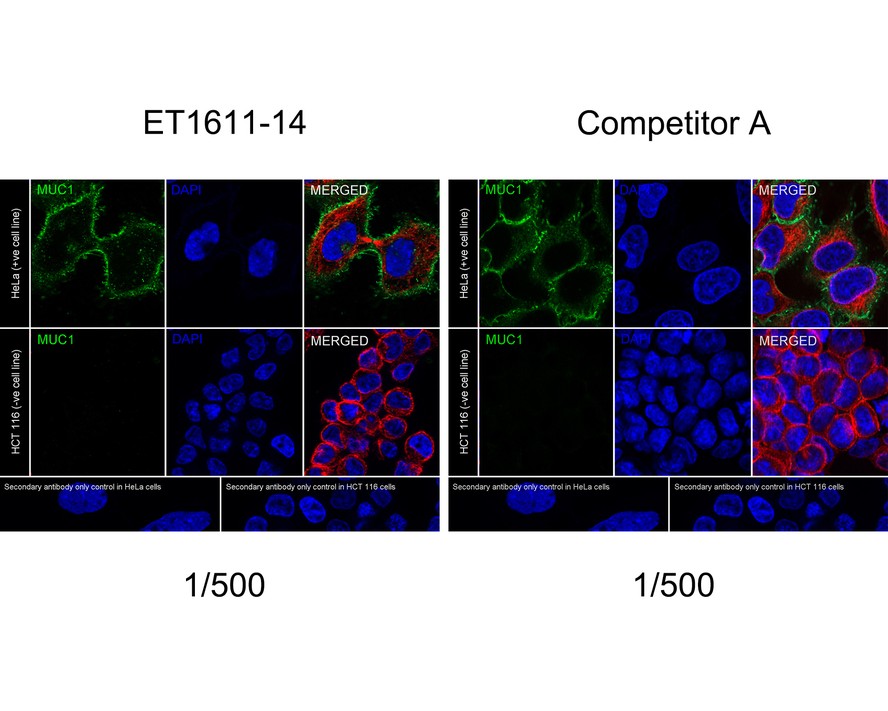
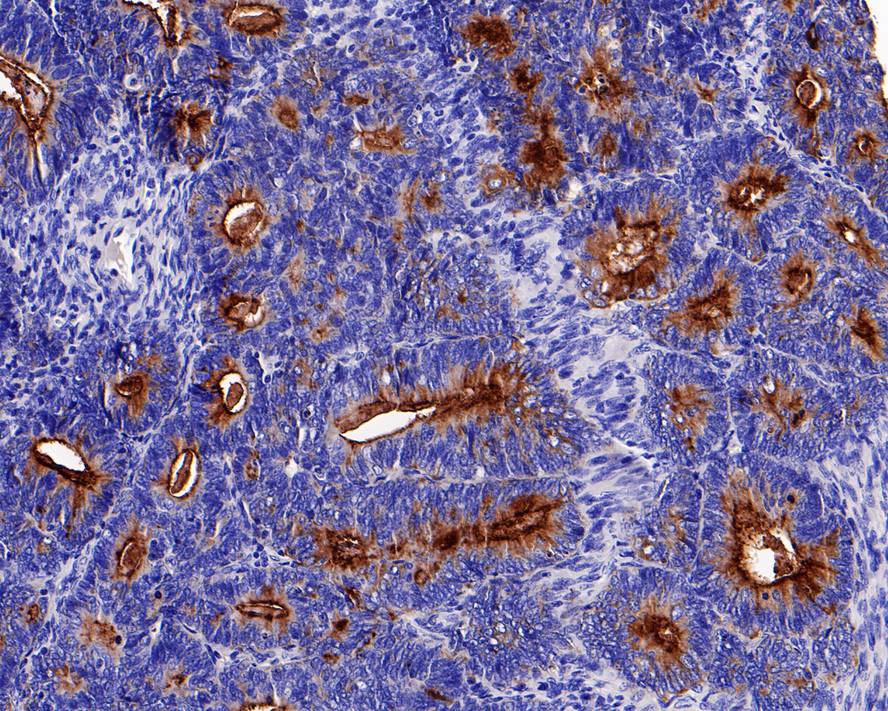
Validation Applications | WB, IF-Cell, IF-Tissue, IHC-P, FC, IP |
分子量 | 预测条带大小:122 kDa |
Molecular Weight | Predicted band size: 122 kDa |
阳性对照 | HeLa细胞裂解液、T-47D细胞裂解液、小鼠肺组织裂解液、大鼠肺组织裂解液、HeLa、B16F1、人肺癌组织、人子宫内膜癌组织、人肾组织 |
Positive Control | HeLa cell lysate, T-47D cell lysate, mouse lung tissue lysate, rat lung tissue lysate, HeLa, B16F1, human lung carcinoma, human endometrial carcinoma, human kidney tissue. |
偶联 | 非偶联 |
Conjugation | Unconjugated |
Clone Number | SN06-80 |
RRID | AB_3069991 |
RRID | AB_3069991 |
产品特性 |
|
Product Characteristics |
|
- 形态 | 液体 |
- Form | Liquid |
- 浓度 | 1ug/ul |
- Concentration | 1ug/ul |
- 存放说明 | 解冻后存放于+4℃。分装后存放于-20℃或-80℃。避免反复冻融。 |
- Storage Instructions | Store at +4℃ after thawing. Aliquot store at -20℃ or -80℃. Avoid repeated freeze / thaw cycles. |
- 存储缓冲液 | 1*TBS (pH7.4), 0.05% BSA, 40% 甘油。防腐剂:0.05% 叠氮化钠。 |
- Storage Buffer | 1*TBS (pH7.4), 0.05% BSA, 40% Glycerol. Preservative: 0.05% Sodium Azide. |
- 亚型 | IgG |
- Isotype | IgG |
- 纯化方式 | Protein A 亲和纯化 |
- Purification Method | Protein A affinity purified. |
应用稀释度 |
|
Application Dilution |
|
- WB | 1:2,000 |
- WB | 1:2,000 |
- IF-Cell | 1:50-1:500 |
- IF-Cell | 1:50-1:500 |
- IF-Tissue | 1:50-1:200 |
- IF-Tissue | 1:50-1:200 |
- IHC-P | 1:50-1:1,000 |
- IHC-P | 1:50-1:1,000 |
- FC | 1:1,000 |
- FC | 1:1,000 |
- IP | 根据实验需求调整浓度 |
- IP | Use at an assay dependent concentration. |
靶点 |
|
Target |
|
- 功能 | MUC1(Mucin 1)是一种细胞表面相关的粘蛋白,也称为多态性上皮粘蛋白(PEM)或上皮膜抗原(EMA),由人类MUC1基因编码。 MUC1是一种糖蛋白,其细胞外域具有广泛的O-连接糖基化。粘蛋白分布在肺、胃、肠、眼睛和其他多个器官的上皮细胞顶膜表面。 MUC1通过其细胞外域的寡糖与病原体结合,防止病原体到达细胞表面,从而保护机体免受感染。MUC1的过表达通常与结肠癌、 乳腺癌、卵巢癌、肺癌和胰腺癌相关。 |
- Function | Mucin 1, cell surface associated (MUC1), also called polymorphic epithelial mucin (PEM) or epithelial membrane antigen or EMA, is a mucin encoded by the MUC1 gene in humans. MUC1 is a glycoprotein with extensive O-linked glycosylation of its extracellular domain. Mucins line the apical surface of epithelial cells in the lungs, stomach, intestines, eyes and several other organs. Mucins protect the body from infection by pathogen binding to oligosaccharides in the extracellular domain, preventing the pathogen from reaching the cell surface. Overexpression of MUC1 is often associated with colon, breast, ovarian, lung and pancreatic cancers. |
背景文献 | Gorges TM et al. Circulating tumour cells escape from EpCAM-based detection due to epithelial-to-mesenchymal transition. BMC Cancer 12:178 (2012).
2. Williams MA et al. Deletion of the mucin-like molecule muc1 enhances dendritic cell activation in response to toll-like receptor ligands. J Innate Immun 2:123-43 (2010).
|
Background References | Gorges TM et al. Circulating tumour cells escape from EpCAM-based detection due to epithelial-to-mesenchymal transition. BMC Cancer 12:178 (2012).
2. Williams MA et al. Deletion of the mucin-like molecule muc1 enhances dendritic cell activation in response to toll-like receptor ligands. J Innate Immun 2:123-43 (2010).
|
组织特异性 | 在气道上皮细胞、乳腺和子宫的顶膜表面表达。也在活化和未活化的T细胞中表达。在乳腺癌、卵巢癌等上皮肿瘤中过表达,也在非上皮肿瘤细胞中表达。 Y亚型仅在肿瘤细胞中表达。 |
Tissue Specificity | Expressed on the apical surface of epithelial cells, especially of airway passages, breast and uterus. Also expressed in activated and unactivated T-cells. Overexpressed in epithelial tumors, such as breast or ovarian cancer and also in non-epithelial tumor cells. Isoform Y is expressed in tumor cells only. |
翻译后修饰 | 高度糖基化(N-和O-连接碳水化合物及唾液酸)。在每个串联重复序列中的丝氨酸和苏氨酸残基上发生不同程度的O-糖基化, 从单糖基化到五糖基化不等。在人类乳汁中糖基化密度约为50%,在T47D乳腺癌细胞中超过90%。在回收过程中进一步唾液酸化。 来自肾和乳腺癌细胞的膜脱落糖蛋白主要具有唾液酸化的核心1结构,而来自相同组织的分泌形式主要显示核心2结构。 O-糖基化内容在这些组织中重叠,末端岩藻糖和半乳糖、2-和3-连接半乳糖、3-和3,6-连接的GalNAc-ol以及4-连接的GlcNAc占主导。 在乳腺癌中差异O-糖基化,具有3,4-连接的GlcNAc。N-糖基化包括高甘露糖、酸性复合型和杂合型聚糖(分泌形式MUC1/SEC) ,以及中性复合型聚糖(跨膜形式MUC1/TM)。 在SEA结构域中的蛋白水解切割在内质网中通过自蛋白水解机制发生,需要完整的SEA结构域以及P+1位点的丝氨酸、苏氨酸或半胱氨酸残基。 该位点的切割也发生在MUC1/X亚型上,但不在MUC1/Y亚型上。外域脱落由ADAM17介导。 CQC基序中的半胱氨酸残基的双棕榈酰化是内体回收至质膜所必需的。C-末端的酪氨酸和丝氨酸残基磷酸化。C-末端酪氨酸磷酸化增加MUC1和β-连环蛋白的核定位。PKCδ介导的磷酸化诱导MUC1与β-连环蛋白/CTNNB1结合, 从而减少β-连环蛋白/E-钙黏蛋白复合物的形成。Src介导的磷酸化抑制与GSK3B的相互作用。Src和EGFR介导的Tyr-1229磷酸化增加与β-连环蛋白/CTNNB1的结合。 GSK3B介导的Ser-1227磷酸化减少这种相互作用,但恢复β-连环蛋白/E-钙黏蛋白复合物的形成。T细胞受体激活时,由LCK磷酸化。 PDGFR介导的磷酸化增加MUC1CT和CTNNB1的核共定位。N-末端序列显示从第24或28位开始。 |
Post-translational Modifications | Highly glycosylated (N- and O-linked carbohydrates and sialic acid). O-glycosylated to a varying degree on serine and threonine residues within each tandem repeat, ranging from mono- to penta-glycosylation. The average density ranges from about 50% in human milk to over 90% in T47D breast cancer cells. Further sialylation occurs during recycling. Membrane-shed glycoproteins from kidney and breast cancer cells have preferentially sialyated core 1 structures, while secreted forms from the same tissues display mainly core 2 structures. The O-glycosylated content is overlapping in both these tissues with terminal fucose and galactose, 2- and 3-linked galactose, 3- and 3,6-linked GalNAc-ol and 4-linked GlcNAc predominating. Differentially O-glycosylated in breast carcinomas with 3,4-linked GlcNAc. N-glycosylation consists of high-mannose, acidic complex-type and hybrid glycans in the secreted form MUC1/SEC, and neutral complex-type in the transmembrane form, MUC1/TM.; Proteolytic cleavage in the SEA domain occurs in the endoplasmic reticulum by an autoproteolytic mechanism and requires the full-length SEA domain as well as requiring a Ser, Thr or Cys residue at the P + 1 site. Cleavage at this site also occurs on isoform MUC1/X but not on isoform MUC1/Y. Ectodomain shedding is mediated by ADAM17.; Dual palmitoylation on cysteine residues in the CQC motif is required for recycling from endosomes back to the plasma membrane.; Phosphorylated on tyrosines and serine residues in the C-terminal. Phosphorylation on tyrosines in the C-terminal increases the nuclear location of MUC1 and beta-catenin. Phosphorylation by PKC delta induces binding of MUC1 to beta-catenin/CTNNB1 and thus decreases the formation of the beta-catenin/E-cadherin complex. Src-mediated phosphorylation inhibits interaction with GSK3B. Src- and EGFR-mediated phosphorylation on Tyr-1229 increases binding to beta-catenin/CTNNB1. GSK3B-mediated phosphorylation on Ser-1227 decreases this interaction but restores the formation of the beta-cadherin/E-cadherin complex. On T-cell receptor activation, phosphorylated by LCK. PDGFR-mediated phosphorylation increases nuclear colocalization of MUC1CT and CTNNB1.; The N-terminal sequence has been shown to begin at position 24 or 28. |
亚细胞定位 | 顶膜、分泌、细胞膜、细胞质、细胞核 |
Subcellular Localization | Apical cell membrane, Secreted, Cell membrane, Cytoplasm, Nucleus. |
UNIPROT # | SwissProt: P15941(人)
SwissProt: Q02496(小鼠)
Entrez Gene: 24571(大鼠) |
UNIPROT # | SwissProt: P15941 Human
SwissProt: Q02496 Mouse
Entrez Gene: 24571 Rat |
别名 | ADMCKD抗体
ADMCKD1抗体
乳腺癌相关抗原DF3抗体
乳腺癌相关抗原DF3抗体
CA 15-3抗体
CA15 3抗体
CA15 3抗原抗体
CA15.3抗体
癌症抗原15-3抗体
癌相关粘蛋白抗体 |
Aliases | ADMCKD antibody ADMCKD1 antibody
Breast carcinoma associated antigen DF3 antibody Breast carcinoma-associated antigen DF3 antibody
CA 15-3 antibody CA15 3 antibody CA15 3 antigen antibody CA15.3 antibody
Cancer antigen 15-3 antibody Carcinoma associated mucin antibody |